Intermediate · Knot guide
Diagonal Clove Hitch
Drawing Diamonds and Vs. Once you can clove hitch on a diagonal, you can draw any shape macramé can draw — diamonds, chevrons, leaves, the iconic V at the bottom of a wall hanging.
How to tie it
1 Why this knot matters
Once you can clove hitch on a diagonal, you can draw any shape macramé can draw — diamonds, chevrons, leaves, the iconic V at the bottom of a wall hanging. Take five minutes to practice it on scrap cord before you start any project that uses it — a clean version of this knot will visibly elevate your finished piece, and a sloppy one will pull the whole project down with it.
2 Step 1
Pick the leftmost cord as the holding cord and angle it down to the right at roughly 45°.
3 Step 2
Take the next cord to its right and tie a clove hitch (two half hitches) around the holding cord.
4 Step 3
Repeat with each subsequent cord, keeping the holding cord under firm tension.
5 Step 4
When you reach the center, switch sides: pick the rightmost cord as a new holding cord and angle it down to the left.
6 Step 5
Clove hitch every cord onto it, working back toward the center.
7 Step 6
The two diagonal lines meet in a V. Cross the holding cords and repeat to form a diamond.
8 Common mistakes
The two most common ways this knot goes wrong: inconsistent tension between knots, and accidentally swapping which cord plays which role. Mark your working cords with a piece of tape until the muscle memory takes over. After a dozen practice repetitions on scrap cord, your hands will know what to do without looking.
9 Where to use it next
Once you have this knot down, every pattern on Fiber Hoard that lists it in its Knots section will feel approachable. Start small — try it in a keychain or coaster project — before scaling up to a wall hanging or curtain. The knot itself is identical at any scale; only the cord length and patience required change.
Patterns that use this knot
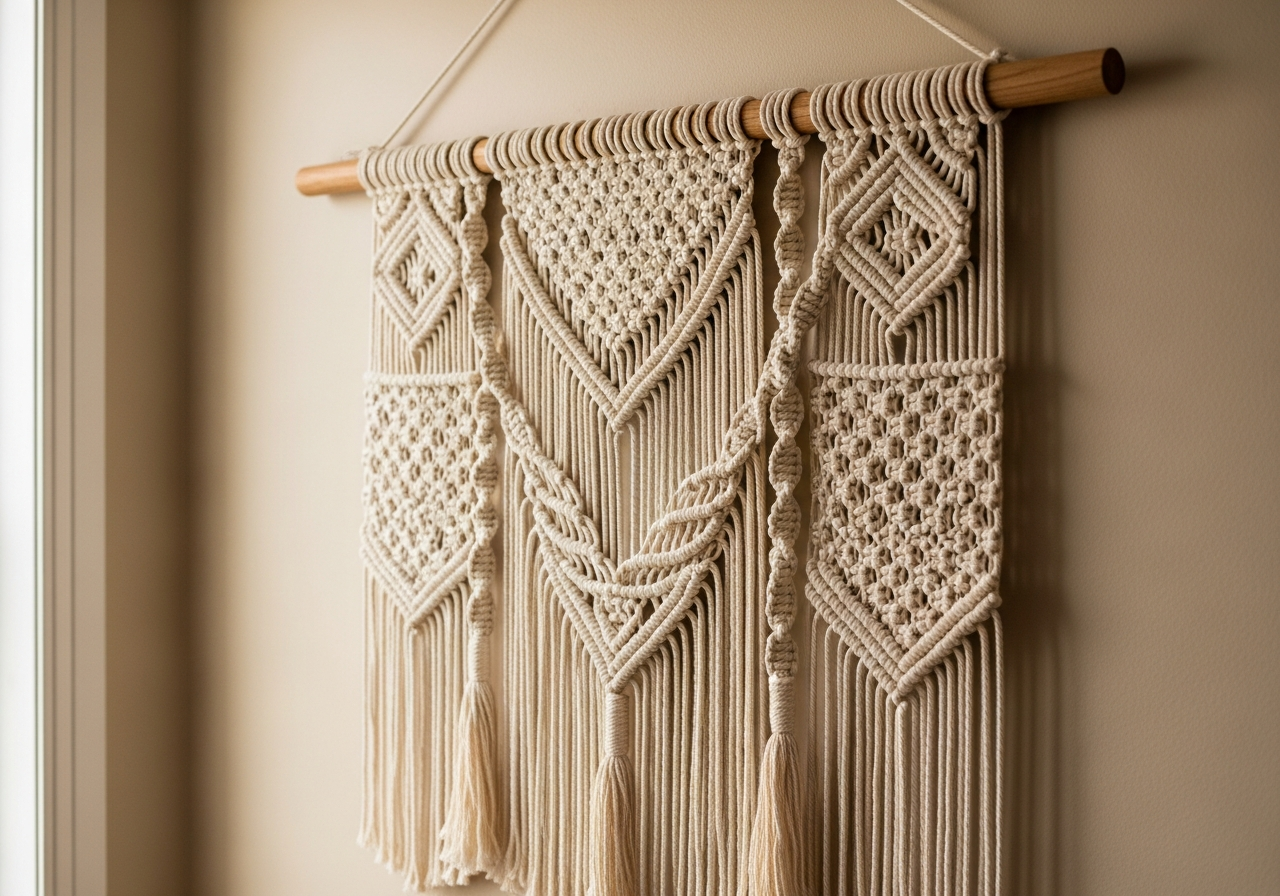 Wall Hanging
Boho Sand Wall Hanging
A intermediate-level wall hanging in the boho style. Combines lark's head knot for a finish that reads as sand and boho. Estimated…
Wall Hanging
Boho Sage Wall Hanging
A advanced-level wall hanging in the boho style. Combines wrap knot for a finish that reads as sage and boho. Estimated finish tim…
Wall Hanging
Boho Natural Wall Hanging
A intermediate-level wall hanging in the boho style. Combines diagonal clove hitch for a finish that reads as natural and boho. Es…
Wall Hanging
Boho Stone Wall Hanging
A intermediate-level wall hanging in the boho style. Combines berry knot for a finish that reads as stone and boho. Estimated fini…
Wall Hanging
Minimalist Cream Wall Hanging
A advanced-level wall hanging in the minimalist style. Combines josephine knot for a finish that reads as cream and minimalist. Es…
Wall Hanging
Minimalist Sand Wall Hanging
A beginner-level wall hanging in the minimalist style. Combines switch knot for a finish that reads as sand and minimalist. Estima…