Learn macramé — a friendly starter guide
Macramé is the craft of making fabric and decorative objects by knotting cord, instead of weaving or stitching it. Almost every pattern on Fiber Hoard — even the architectural ones — is built from a small handful of foundational knots. Learn those first and the rest is repetition.
What you actually need to start
You can begin with surprisingly little. A good first kit is one ball of 4 mm or 5 mm three-ply cotton cord (about 50 m), a 12-inch wooden dowel, a pair of sharp fabric scissors, and a measuring tape. That’s it. You do not need a clipboard, a knotting board, special pins, or branded "macramé combs" to make your first wall hanging. You can add those tools later if you decide you love the craft.
The single biggest beginner mistake is buying the wrong cord. Avoid anything labeled "rope" with a hard, slick exterior — it won’t fray into the soft fringe most patterns rely on. Also avoid anything thinner than 3 mm for your first project; thin cord makes for slow knotting and your hands will cramp.
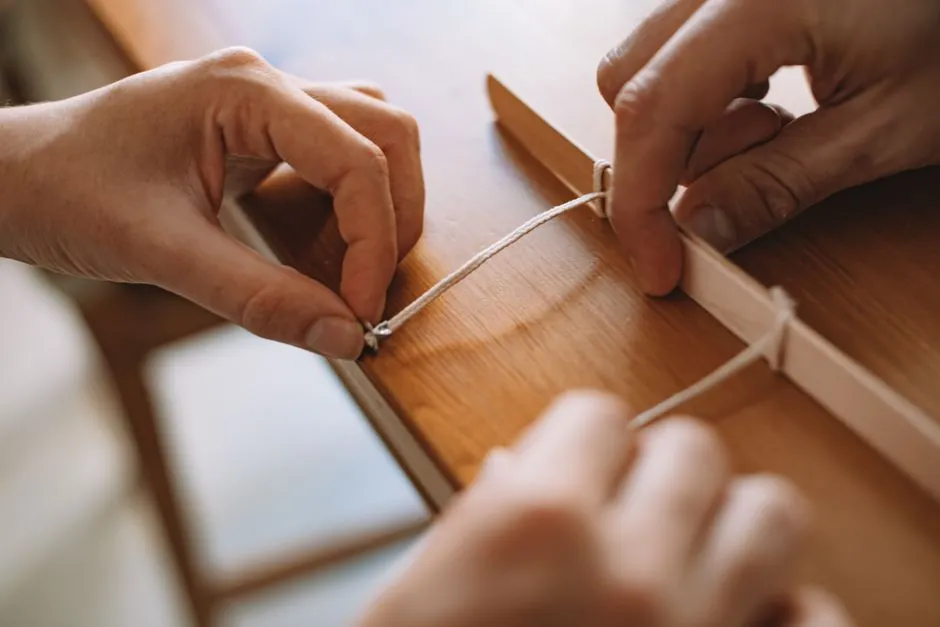
The seven foundational knots
If you can do these seven knots, you can make almost any pattern in the Fiber Hoard library. Practice each one with a one-meter scrap of cord before you commit to a real project.
1. Lark’s Head Knot
The mounting knot. Fold a cord in half, drape the loop behind your dowel, fold the loop forward over the top, and pull the two tails through the loop. Tighten gently. Every project starts with a row of these.
2. Square Knot
The most common decorative knot in all of macramé. Worked with four cords: two outer "working" cords and two inner "filler" cords. Cross the left working cord over the fillers and under the right; cross the right working cord under the fillers and up through the loop on the left. Repeat in the mirror direction. That’s one square knot.
3. Half Square Knot
The first half of a square knot. If you stack only the same half repeatedly, the work twists into a corkscrew — that’s the spiral knot you see in plant hangers. If you alternate the halves, you get a flat band.
4. Half Hitch
A one-cord wrap. Take a working cord and loop it around a holding cord twice. By itself it’s nothing; stacked, it builds horizontal and diagonal lines.
5. Diagonal Clove Hitch
Two stacked half hitches around a holding cord, worked along a diagonal. Used to draw the V shapes, diamonds, and chevron lines you see in nearly every wall hanging.
6. Berry Knot
A small cluster of square knots folded back on themselves to create a raised bobble. The first textural knot most makers learn. It looks much harder than it is.
7. Wrap Knot (Gathering Knot)
Used to bundle a group of cords together — the top of a plant hanger, the base of a tassel, anywhere a clean wrap is needed. Wrap a single cord tightly around the bundle, then tuck the ends inside.
How to read a Fiber Hoard pattern
Every Fiber Hoard pattern starts with a materials list (cord type, total length, hardware), a list of the knots you’ll use, and an estimated finish time. The instructions are written in the order you’ll work them. Read the whole pattern through once before cutting any cord — it’s much easier to spot a step that requires a piece of hardware you don’t own when you haven’t already invested an hour.
Setting up your workspace
Hang your dowel at roughly chest height — too high and your shoulders will ache; too low and you’ll hunch. A simple S-hook over the top of a door, or two screw eyes in a wall stud, both work. Keep your scissors and tape close. If you’re working on a small project like a keychain, tape it down to a flat table instead.
Common beginner problems
The piece slants to one side. Your tension is uneven. Slow down and check your work after every full row.
The cords keep tangling. Pre-cut cords always tangle a little. Bundle the bottom of each cord with a rubber band to keep them out of the way until you need them.
The fringe is frizzy and uneven. Don’t comb until the piece is fully hung. Then mist with water and comb with a wide-tooth comb downward in long, gentle strokes.
What to make first
A small wall hanging or a single plant hanger. Both use only a handful of knots, take a couple of hours, and produce a finished object you’ll actually want to keep. Browse beginner wall hangings or plant hangers to find one you like.