Beginner · Knot guide
Half Hitch
The Building Block of Lines. A half hitch is the simplest one-cord wrap in macramé. Stack two of them and you have a clove hitch — the basis of every diagonal line, diamond, and chevron.
How to tie it
1 Why this knot matters
A half hitch is the simplest one-cord wrap in macramé. Stack two of them and you have a clove hitch — the basis of every diagonal line, diamond, and chevron. Take five minutes to practice it on scrap cord before you start any project that uses it — a clean version of this knot will visibly elevate your finished piece, and a sloppy one will pull the whole project down with it.
2 Step 1
Choose a HOLDING cord (it stays straight) and a WORKING cord (it does the wrapping).
3 Step 2
Bring the working cord up and over the holding cord, then back under and up through the loop it created.
4 Step 3
Pull the working cord down to tighten. That is one half hitch.
5 Step 4
Repeat the same motion with the same working cord — over, under, up through. That second hitch makes a clove hitch.
6 Step 5
To draw a diagonal line, hold the holding cord on a 45° angle and clove-hitch every working cord across it in turn.
7 Common mistakes
The two most common ways this knot goes wrong: inconsistent tension between knots, and accidentally swapping which cord plays which role. Mark your working cords with a piece of tape until the muscle memory takes over. After a dozen practice repetitions on scrap cord, your hands will know what to do without looking.
8 Where to use it next
Once you have this knot down, every pattern on Fiber Hoard that lists it in its Knots section will feel approachable. Start small — try it in a keychain or coaster project — before scaling up to a wall hanging or curtain. The knot itself is identical at any scale; only the cord length and patience required change.
Patterns that use this knot
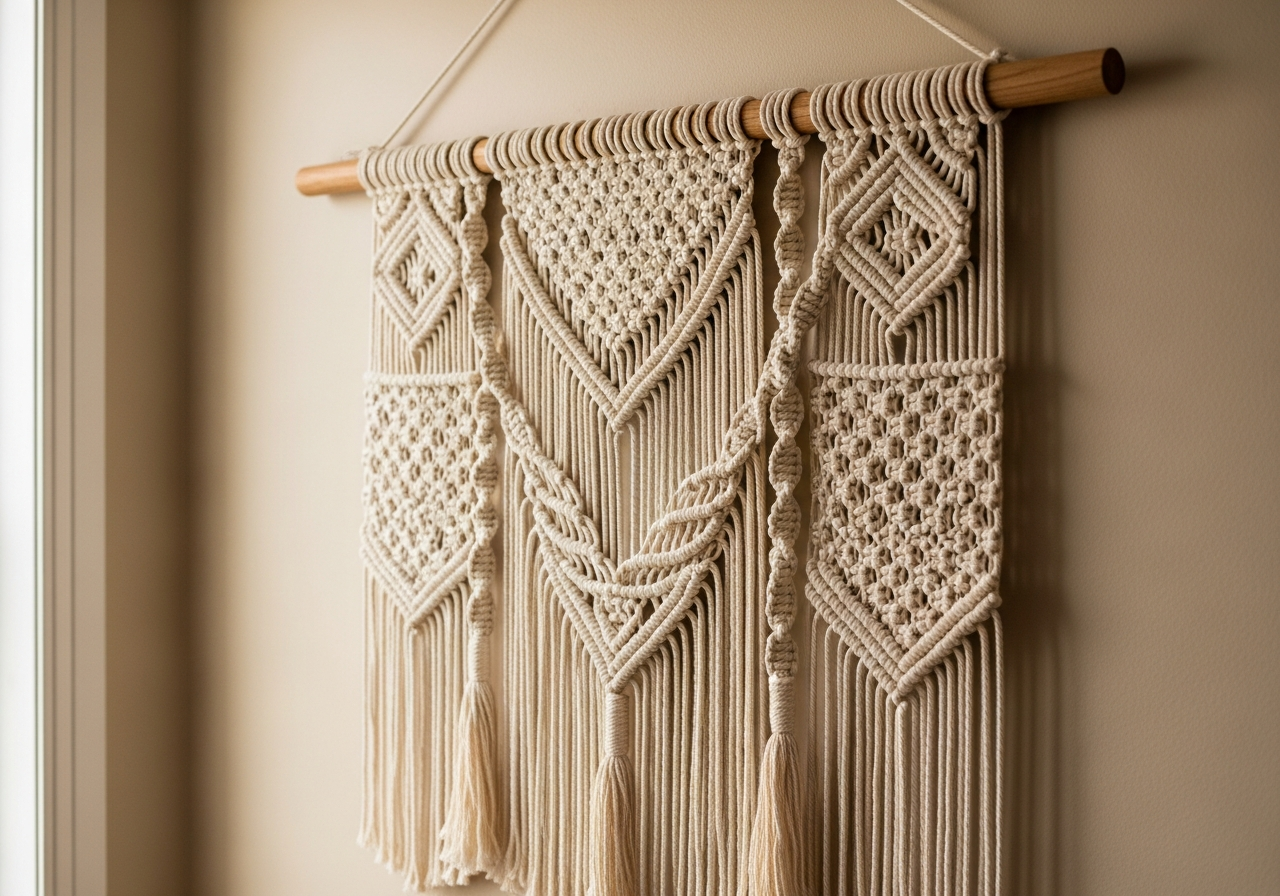 Wall Hanging
Boho Terracotta Wall Hanging
A beginner-level wall hanging in the boho style. Combines half hitch for a finish that reads as terracotta and boho. Estimated fin…
Wall Hanging
Boho Linen Wall Hanging
A beginner-level wall hanging in the boho style. Combines half square knot for a finish that reads as linen and boho. Estimated fi…
Wall Hanging
Minimalist Cream Wall Hanging
A advanced-level wall hanging in the minimalist style. Combines josephine knot for a finish that reads as cream and minimalist. Es…
Wall Hanging
Minimalist Sage Wall Hanging
A intermediate-level wall hanging in the minimalist style. Combines half hitch for a finish that reads as sage and minimalist. Est…
Wall Hanging
Minimalist Terracotta Wall Hanging
A advanced-level wall hanging in the minimalist style. Combines half hitch for a finish that reads as terracotta and minimalist. E…
Wall Hanging
Minimalist Stone Wall Hanging
A beginner-level wall hanging in the minimalist style. Combines wrap knot for a finish that reads as stone and minimalist. Estimat…