Beginner · Knot guide
Wrap Knot
Finishing Tassels. A wrap knot binds a bundle of cords together at a single point — the top of a tassel, the neck of a plant hanger, the gathered end of a curtain. It is essentially decorative whipping.
How to tie it
1 Why this knot matters
A wrap knot binds a bundle of cords together at a single point — the top of a tassel, the neck of a plant hanger, the gathered end of a curtain. It is essentially decorative whipping. Take five minutes to practice it on scrap cord before you start any project that uses it — a clean version of this knot will visibly elevate your finished piece, and a sloppy one will pull the whole project down with it.
2 Step 1
Cut a single working cord roughly 24 inches long and set it aside.
3 Step 2
Hold the bundle of cords you want to gather. Lay the working cord against the bundle so one short tail (about 2 inches) points down.
4 Step 3
Form a long loop with the rest of the working cord pointing UP.
5 Step 4
Wrap the long end downward around the bundle, covering the short tail. Wrap tightly, neat coils, side by side.
6 Step 5
After eight to twelve wraps, thread the long end through the small loop at the bottom.
7 Step 6
Pull the short tail at the top — this drags the loop (and your working end) up under the wraps and locks it. Trim both tails flush.
8 Common mistakes
The two most common ways this knot goes wrong: inconsistent tension between knots, and accidentally swapping which cord plays which role. Mark your working cords with a piece of tape until the muscle memory takes over. After a dozen practice repetitions on scrap cord, your hands will know what to do without looking.
9 Where to use it next
Once you have this knot down, every pattern on Fiber Hoard that lists it in its Knots section will feel approachable. Start small — try it in a keychain or coaster project — before scaling up to a wall hanging or curtain. The knot itself is identical at any scale; only the cord length and patience required change.
Patterns that use this knot
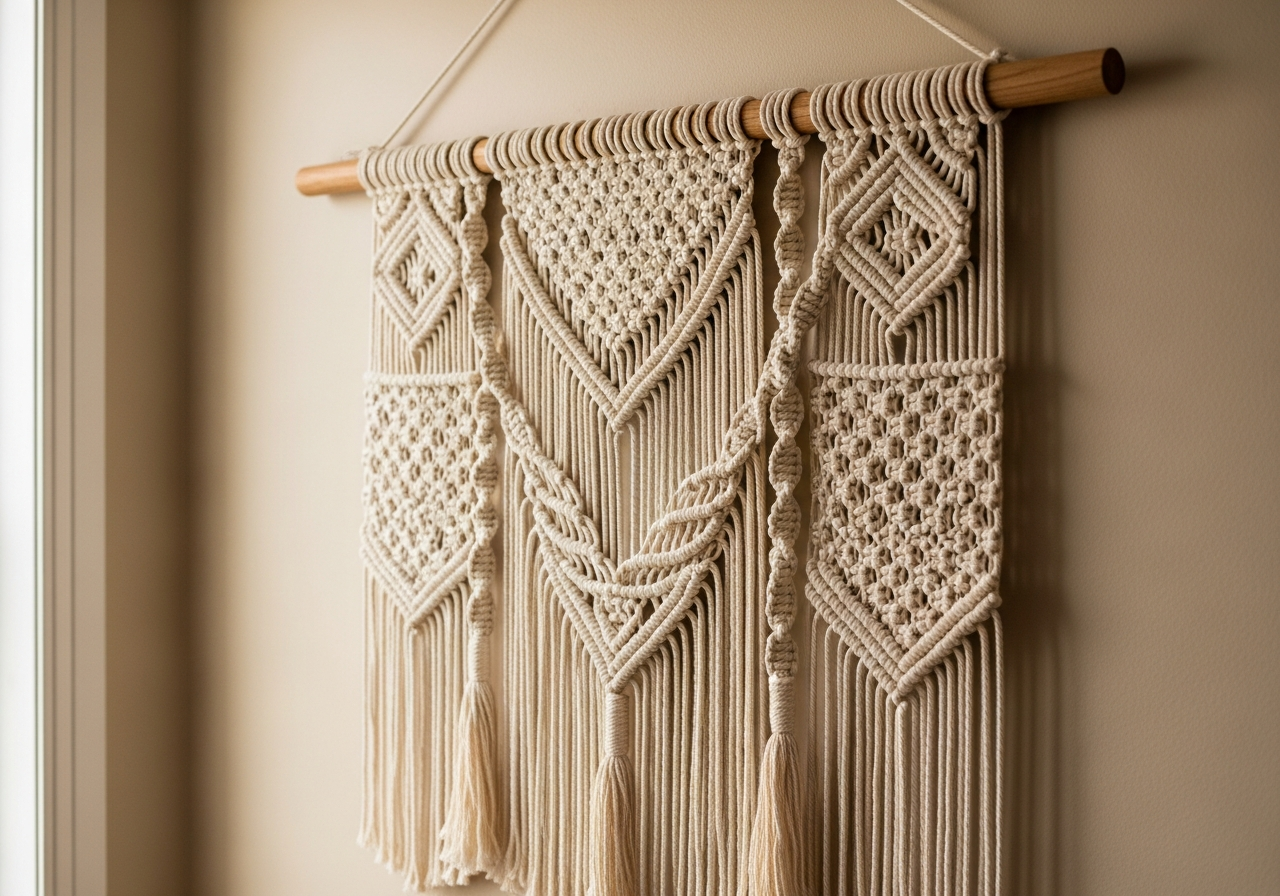 Wall Hanging
Boho Cream Wall Hanging
A beginner-level wall hanging in the boho style. Combines switch knot for a finish that reads as cream and boho. Estimated finish …
Wall Hanging
Boho Sage Wall Hanging
A advanced-level wall hanging in the boho style. Combines wrap knot for a finish that reads as sage and boho. Estimated finish tim…
Wall Hanging
Boho Natural Wall Hanging
A intermediate-level wall hanging in the boho style. Combines diagonal clove hitch for a finish that reads as natural and boho. Es…
Wall Hanging
Minimalist Terracotta Wall Hanging
A advanced-level wall hanging in the minimalist style. Combines half hitch for a finish that reads as terracotta and minimalist. E…
Wall Hanging
Minimalist Driftwood Wall Hanging
A intermediate-level wall hanging in the minimalist style. Combines half square knot for a finish that reads as driftwood and mini…
Wall Hanging
Minimalist Stone Wall Hanging
A beginner-level wall hanging in the minimalist style. Combines wrap knot for a finish that reads as stone and minimalist. Estimat…